
Tracemark
Sustainability reporting your auditor can trust.
Tracemark is the platform that turns a company's sustainability data into disclosures that hold up to scrutiny. Every figure it produces can be traced back to the record it came from, the evidence behind it, and the person who approved it.
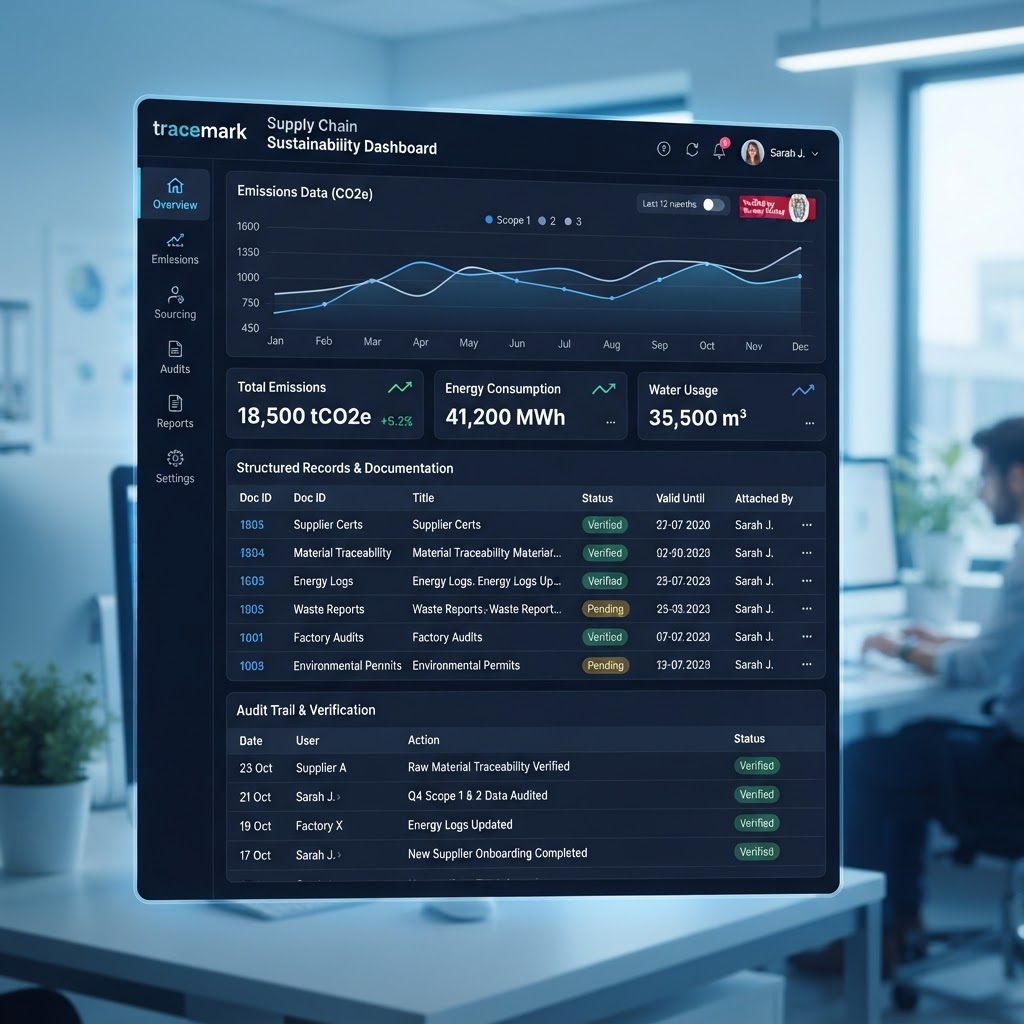
Most sustainability reporting is built on spreadsheets that no one can audit.
Numbers are copied between files, factors are pasted from memory, and by the time a figure reaches the board or the regulator, no one can say exactly where it came from or who signed it off. As disclosure standards tighten and assurance becomes mandatory, that approach stops being good enough.
Tracemark was built for the opposite: a single, controlled system where every reported number carries its own proof.
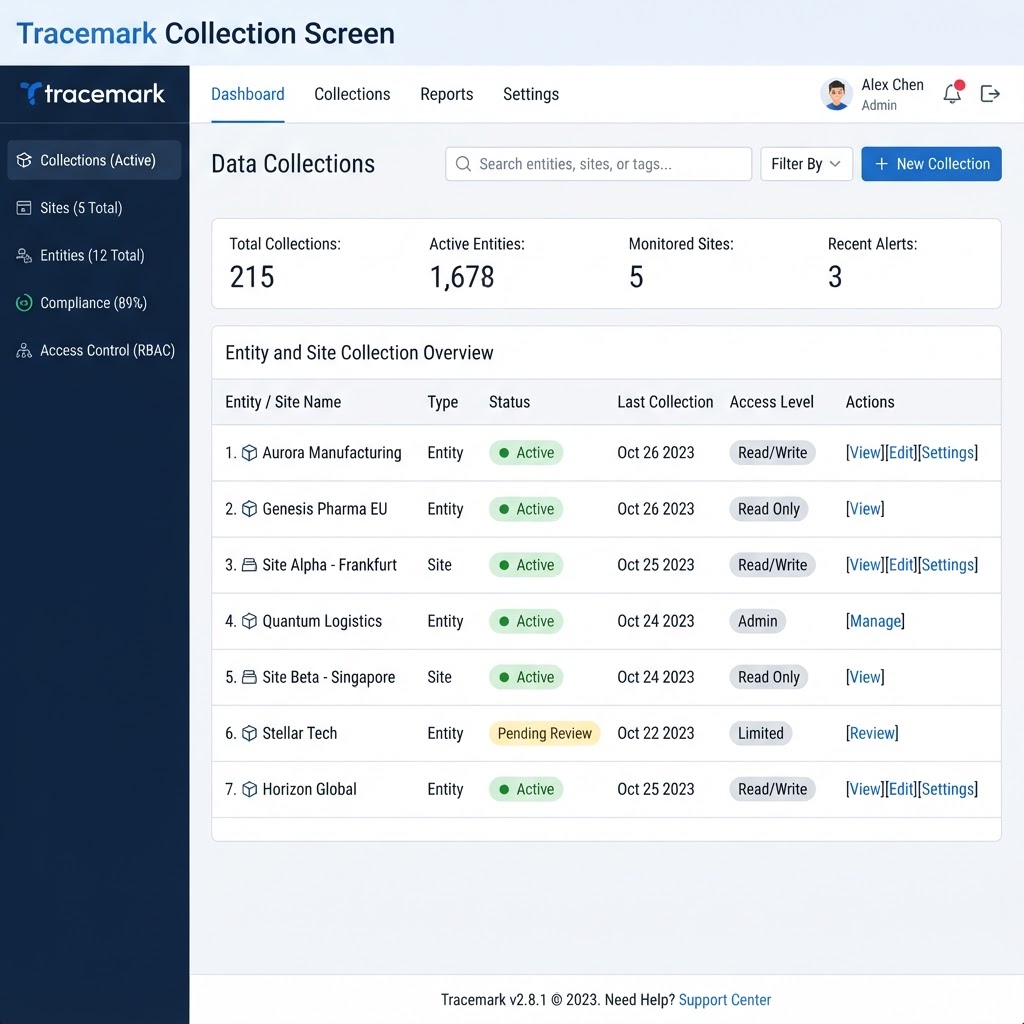
Multi entity collection.
Built for groups. Collect across many subsidiaries and sites, with each user seeing only what their role and their scope permit.
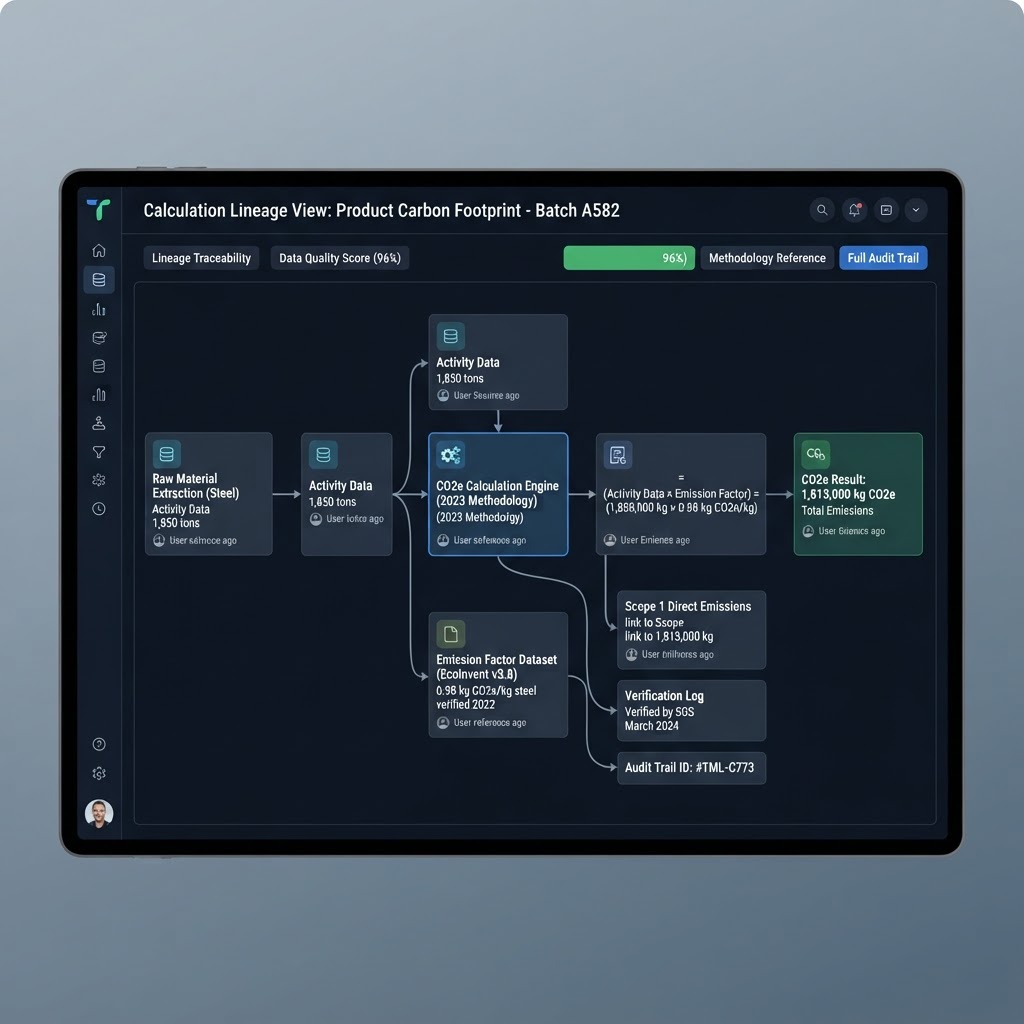
A governed calculation engine.
Emissions and metrics are computed by a sealed engine from a versioned factor library, so any figure can be reproduced by hand and defended in an audit.
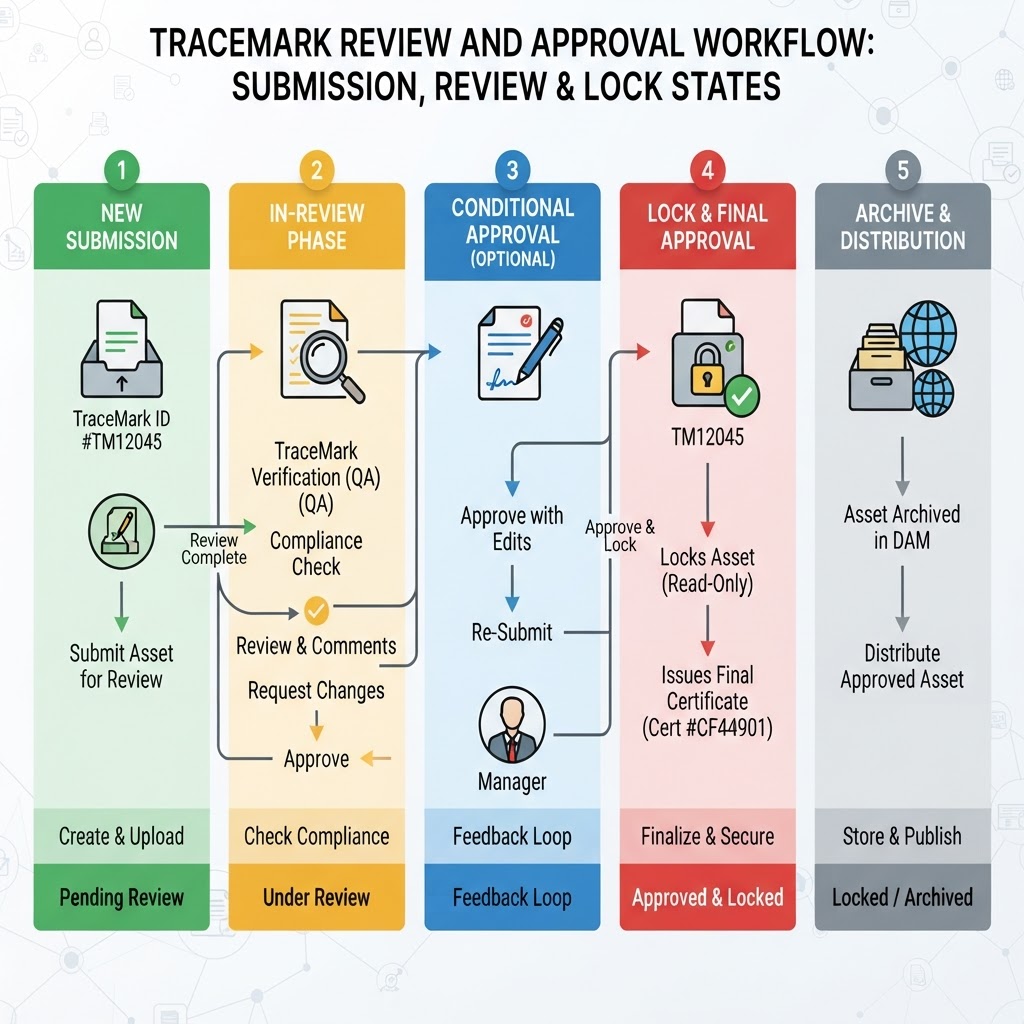
Controls and governance.
A maker and checker workflow, segregation of duties, and approved figures that cannot be altered, even with direct database access.
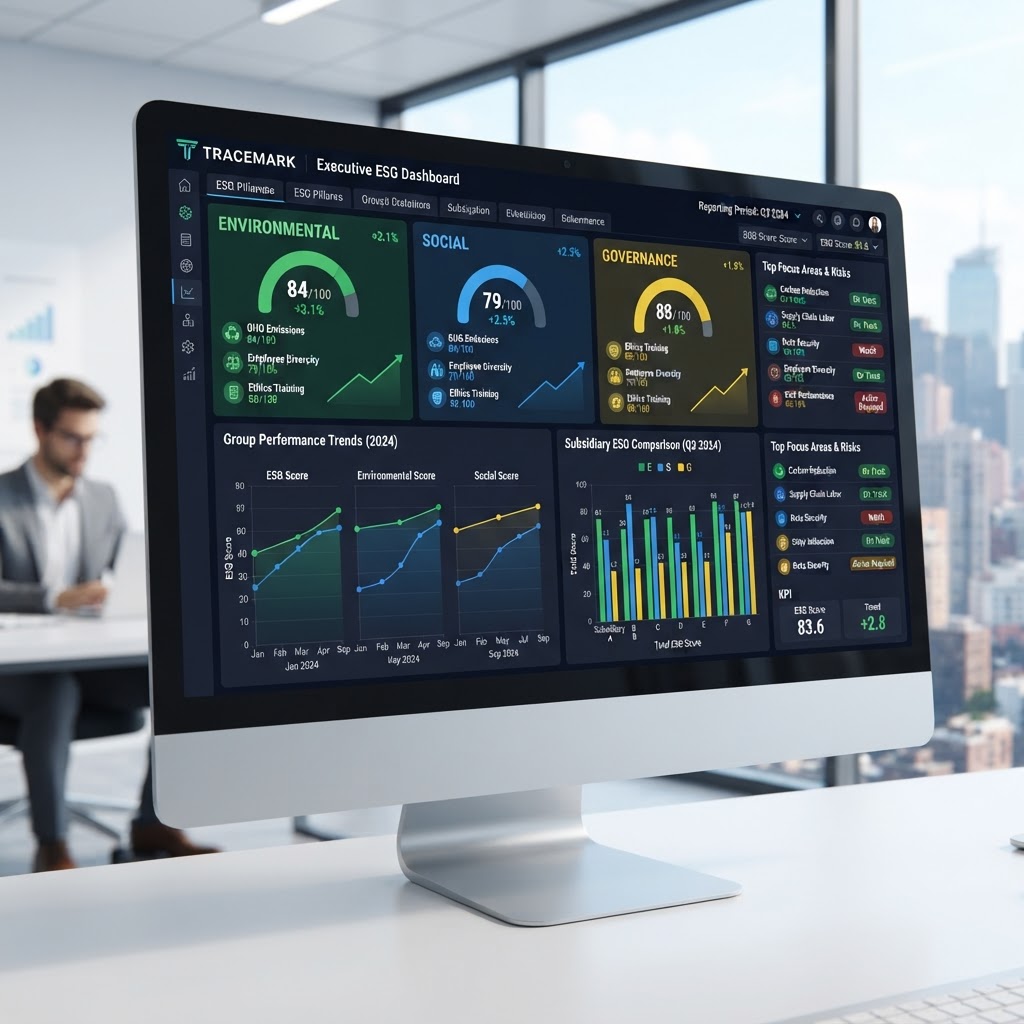
An executive dashboard.
Performance across all three pillars, emissions trends, subsidiary comparison, data quality, and a plain language read of what changed and what needs attention, with every figure traceable.
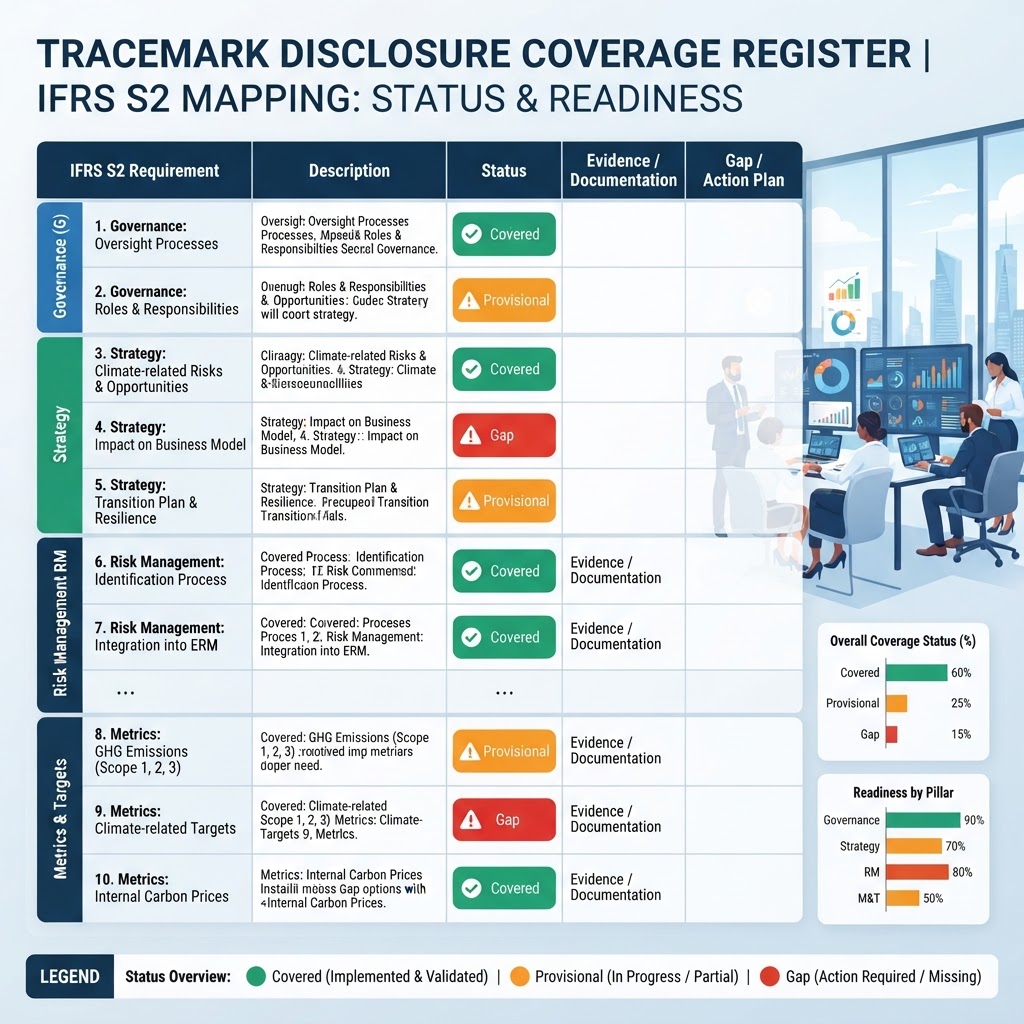
Disclosure coverage.
A live register showing, requirement by requirement, what is covered, what is provisional, and what is still a gap against each framework.
A complete audit trail.
Every action recorded and immutable, with the full evidence chain preserved for assurance.
Local factor content.
Emission factors sourced for the markets where our customers operate, so the numbers reflect the grid and the fuels they actually use.
Six steps from data to disclosure
Configure.
Set up the group, its legal entities, its sites and assets, and the reporting year.
Collect.
Preparers enter activity data, month by month and site by site, across the environmental, social and governance pillars, with progress visible throughout.
Control.
Nothing is reported on trust. Submissions move through a maker and checker workflow: a preparer submits, a reviewer returns or approves, and approved figures lock.
Calculate.
Activity data becomes emissions and metrics through a versioned library of emission factors, never a hard coded number, so every result is reproducible.
Disclose.
Figures map to the requirements of the reporting frameworks, each marked covered, provisional or a gap, so a company always knows where it stands.
Assure.
An immutable audit trail records every action, and every figure opens to its full lineage and evidence, so an auditor can follow any number to its source.
Standards it aligns with.
Tracemark aligns disclosures with IFRS S1 and IFRS S2, the Global Reporting Initiative, SASB standards, and the Nairobi Securities Exchange sustainability guidance. It structures the requirements and preserves the evidence behind each one. It supports a company towards compliance and assurance; it does not itself certify compliance, and that honesty is deliberate.
Who it is for.
Companies with subsidiaries that need to report sustainability data credibly: sustainability managers who collect and prepare the data, chief financial officers who answer for the numbers, and auditors who have to test them. Built first for Kenya and East Africa, with local factor content and local support, and designed to serve companies across Africa and the United States.
What makes it different.
Every figure is defensible. The trace from a headline number to its evidence is the product, not an add on. Competitors show a dashboard; Tracemark shows the proof beneath it.
No number is ever invented. Calculations are deterministic and reproducible. No estimate is ever presented as a fact, and no artificial intelligence decides a reported figure.
The database enforces the promises. Tenant separation and the immutability of approved figures are enforced at the data layer, not merely by the interface, which is a far stronger claim to make to an auditor.
Local where it counts. Factor libraries and support built for the markets our customers actually operate in.
One system that scales. Serving many companies from one platform, so the product grows without a separate installation per customer.
Priced on entities, not seats.
Tracemark is priced on the number of legal entities a company reports on, because that is what reflects both the value delivered and the work involved. Plans run from a single entity to large groups, available monthly or annually, with enterprise arrangements for regulated and listed companies.
Standalone
For a single company. Monthly or annual.
Group
For companies with several entities.
Enterprise
For listed, regulated or larger groups.
Pricing figures will be confirmed shortly. Plans available monthly or annually.
Built so the promises hold.
Tracemark is built so that one customer's data is invisible to another at the database level, approved figures cannot be altered even with direct database access, and every action is recorded on an immutable trail.
Read the privacy policyTenant separation at the data layer
One customer's data is invisible to another at the database level. This is enforced in the data layer, not merely by the interface.
Immutable approved figures
Approved figures cannot be altered, even with direct database access. Once a figure locks, it stays locked.
An immutable audit trail
Every action is recorded on an immutable trail. Nothing is deleted, nothing is edited after the fact.
Private evidence documents
Evidence documents are private and reachable only through the platform's own permission checks.
On the roadmap
These are planned. They are presented here as what is coming, not as what ships today.
Materiality assessment
A materiality assessment that guides a company through deciding what is material and drives what it collects.
Location intelligence
Location intelligence that maps a group's footprint.
Climate scenario and targets
Climate scenario and targets modules.
Guided learning layer
A guided learning layer that teaches as the user works.
Common questions
IFRS S1 and IFRS S2, the Global Reporting Initiative, SASB standards, and the Nairobi Securities Exchange sustainability guidance. Tracemark structures the requirements and preserves the evidence; it does not itself certify compliance.
Through a versioned factor library. No factor is ever a hard coded number, so every result can be reproduced by hand.
No. Once approved, figures lock and cannot be altered, even with direct database access. That is enforced at the data layer.
No. Tenant separation is enforced at the database level, and evidence documents are reachable only through the platform's own permission checks.
No. Calculations are deterministic and reproducible, and no artificial intelligence decides a reported figure.
On the number of legal entities a company reports on, from a single entity to large groups, monthly or annually, with enterprise arrangements for regulated and listed companies.
Reporting that defends itself.
Book a walkthrough and see the trace behind every number.
A Vespera Digital product